


Sun Tunnel in Commercial Buildings for Natural Lighting
In commercial architecture, light has long been perceived as a secondary element. Today it is treated as one of the basic tools for shaping space, alongside structure and zoning.
This is especially noticeable in the deeper parts of buildings. In windowless spaces, lighting has a direct influence on how people perceive the environment.
In such areas, the search begins for ways to bring daylight into the building. One solution is the Sun Tunnel, a system that transmits natural light through a reflective channel that works like an optical conductor.
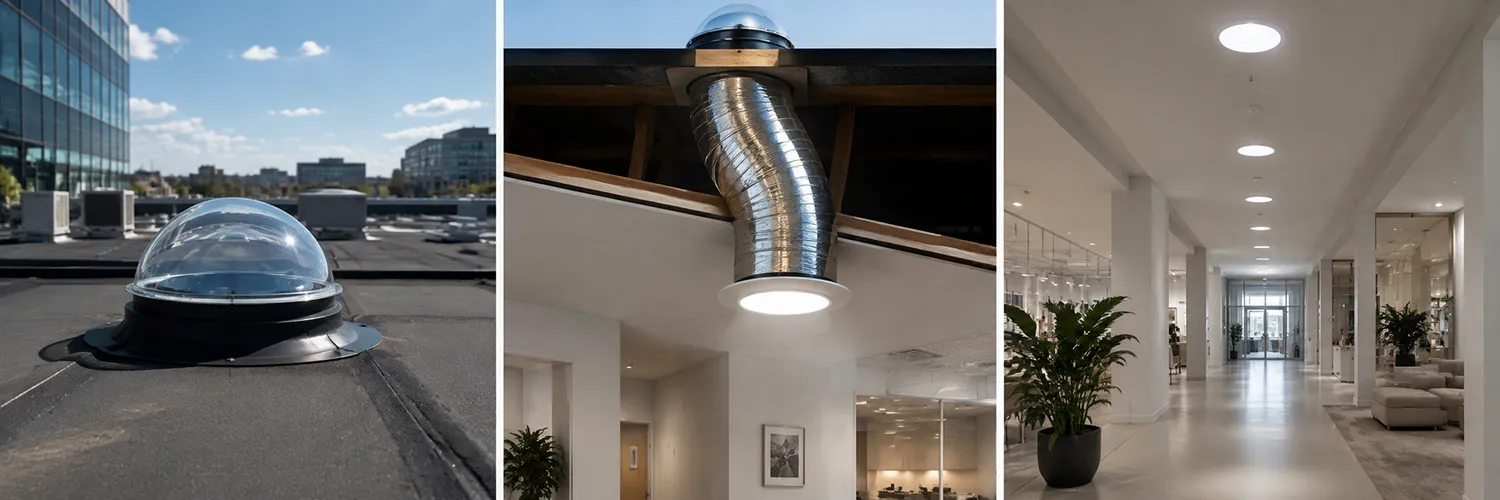
How the Sun Tunnel Works in Commercial Buildings
The Sun Tunnel is a tubular daylighting system integrated into the roof and ceiling structure. On the outside, it is a small dome on the roof. Inside, there is a reflective channel and a diffuser that distributes light in the space.
Light enters the dome, is reflected inside a highly efficient tube, and travels to the interior space while maintaining a significant part of its intensity. In commercial VELUX solutions, a highly reflective coating is used in the channel, reducing light loss along the length of the tube.
As a result, light can be precisely directed and distributed along a preplanned trajectory.
Technology That Works with the Precision of an Engineering Solution
At the core of the Sun Tunnel is a relatively simple idea, but its execution requires precision.
The dome on the roof collects daylight from different angles throughout the day. The internal channel reflects it with high efficiency, and the ceiling diffuser distributes the light in the space in a soft and even way.
VELUX systems use solutions adapted to commercial architecture, including rigid and flexible channels, fast installation components, and diffusers for different ceiling types.
The system does not require radical intervention in the building structure. It integrates easily into an existing commercial building, which is especially important in renovation or modernization projects.
Where the Sun Tunnel Performs Best
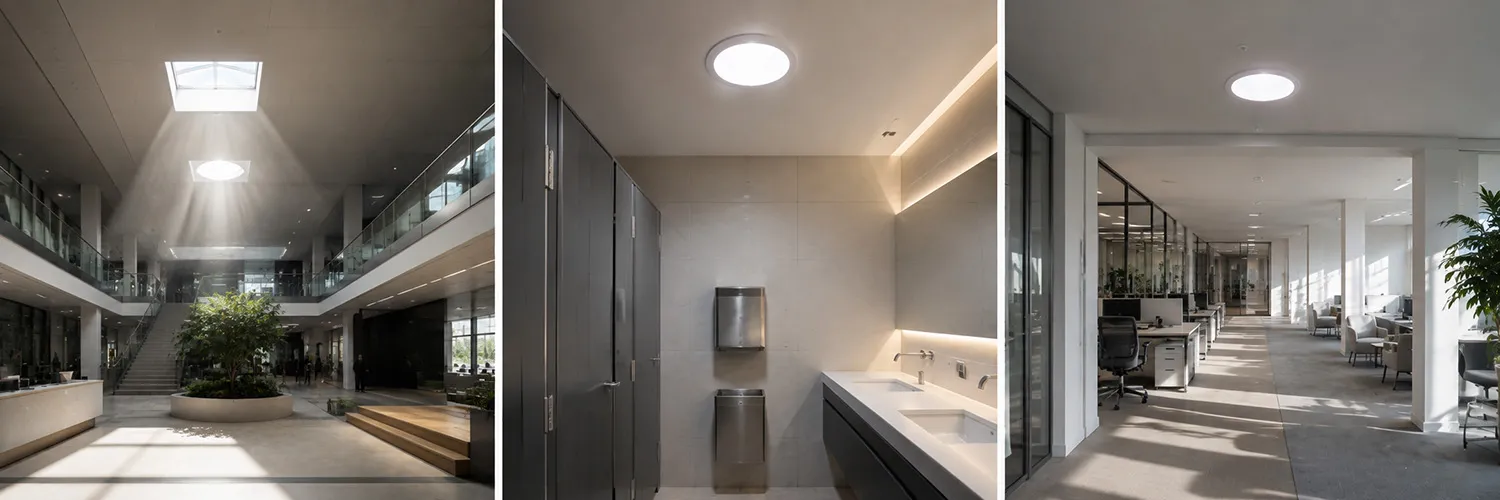
There are spaces where the Sun Tunnel most noticeably changes the perception of the interior.
- Most often, these are office building corridors, long and with uniform artificial lighting.
- Sanitary areas that are usually designed without windows.
- Internal spaces in retail facilities.
- Educational and medical buildings where deep zones occupy a large part of the floor area.
In such places, the Sun Tunnel brings daylight into areas where it did not exist before.
Frequently Asked Questions about the Sun Tunnel
Can the Sun Tunnel Be Directed to the Most Remote Areas of a Building?
Yes. The system is used for deep interior spaces that facade light does not reach.
How Much Light Actually Reaches the Space?
The amount of light depends on the length and configuration of the channel, but the reflective surface helps preserve a significant portion of daylight along the way.
How Does the Lighting System Work with Complex Roof Geometry?
The system adapts to different angles and configurations, including sloped and flat roofs, thanks to the modular channel design and the possibility of combining elements.
Can Multiple Sun Tunnels Be Used in One Space?
Yes. This is a common solution for achieving uniform lighting in large spaces.
Is the Light Source Visible inside the Space?
No. Only soft diffused daylight is visible through the diffuser, without any visual perception of the light channel itself.
Can the Sun Tunnel Be Combined with Artificial Lighting?
Yes. The system works together with electric lighting and reduces its use during the day.
As cities become denser and the layouts of commercial buildings more complex, the role of solutions that bring daylight back into buildings becomes more noticeable.