


Fresh Air Skylights: Solar, Electric, and Manual
Opening skylights are commonly used in living rooms, kitchens, bathrooms, and other interior spaces to improve daylight and ventilation.
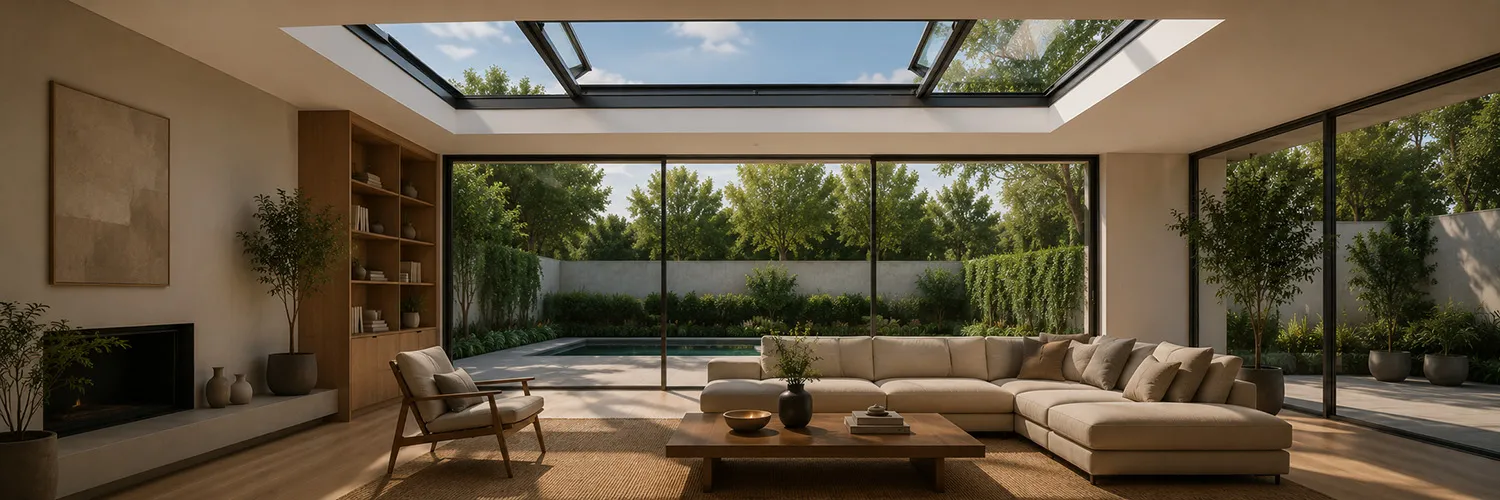
System Design and Logic
Fresh Air Skylights are available in fixed and opening models. Fixed models are designed for daylighting, while opening models also provide ventilation.
In opening skylights, the sash can be set at different angles to control airflow. Fresh air enters through the opening, and warm air rises and exits through the upper part of the space, creating natural circulation.
All opening models have the same basic structure, but they differ in the type of control: manual, electric, or solar. This determines how the window is opened and how easy it is to use.
Manual Control
Manual Fresh Air Skylights are opened using a handle or an operating rod. In relation to window placement, either a handle is used for close-range access, or a special rod for windows located above arm’s reach.
This is a mechanical solution that does not require connection to the power grid. Control is fully carried out by the user.
Electric Control
Electric skylights are controlled using a wall switch or a button. Opening and closing is carried out by signal, without direct contact with the window.
The system is connected to the power grid and is suitable for windows located in hard-to-reach areas.
Solar Control
Solar Fresh Air Skylights are equipped with a built-in solar panel that powers the mechanism. The system operates without connection to the power grid. Control is carried out in the same way as in electric models, but power is fully autonomous and depends on solar energy.
Additional Features
Fresh Air Skylights can be equipped with built-in features that improve ease of use. For example, a rain sensor automatically closes the window during precipitation.
Additional features improve everyday use: mosquito screens allow ventilation while keeping insects out, and electric and solar models typically include remote control.
Opening Skylights work with what is already built into a building’s architecture: light and air movement in the upper part of the space. Different control systems only determine the level of control and ease of use in everyday operation.